
TYLER HILL, PA — It’s late November, and a flock of construction-yellow excavators are chewing up the earth in a field in Damascus Township, Wayne County. They’re installing a …
Stay informed about your community and support local independent journalism.
Subscribe to The River Reporter today. click here
This item is available in full to subscribers.
Please log in to continue |

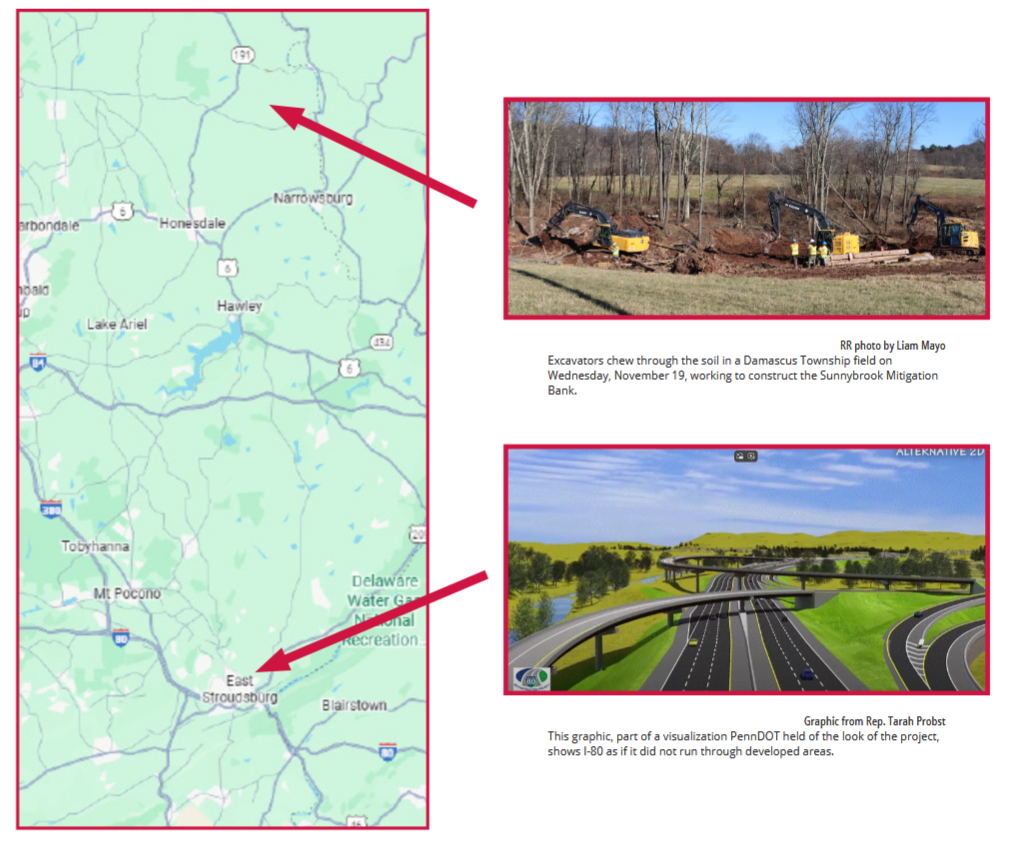
TYLER HILL, PA — It’s late November, and a flock of construction-yellow excavators are chewing up the earth in a field in Damascus Township, Wayne County. They’re installing a stream and wetland complex that will improve the health and water quality of North Branch Calkins Creek, a stream that feeds into the Delaware River.
Fifty miles south and two counties away, a $935 million highway expansion is about to begin in Stroudsburg, Monroe County, after spending over a decade in development. The Pennsylvania Department of Transportation (PennDOT) says it wants to improve safety and efficiency in the region; Stroudsburg residents and representatives have concerns that the project is too big, and as currently designed, will have negative effects on the area’s economy and ecology.
At first glance, these projects have very little in common. What connects them are the wetlands one project will enhance and the other will impair, and the regulatory structure that allows the one project’s benefits to offset the other’s harms.
PennDOT’s $935 million project will upgrade and expand I-80 along a 3.5 mile stretch which runs through Stroud Township and the boroughs of Stroudsburg and East Stroudsburg, Monroe County. Planned work includes the highway’s expansion from four lanes to six, as well as expanded shoulders.
The construction as planned runs through a patch of wetland in Stroudsburg Borough. (For more on wetlands, and their importance to the natural world, see sidebar.) According to an independent Wetlands and Waters Identification and Delineation Report prepared by Cherry Ridge Consulting LLC, the area includes a primary vernal pool (i.e., a pool that forms seasonally in the spring) with forested wetland at the edges.
Wetlands have a number of legal protections. In this case, to make up for the impact to wetlands from the I-80 project, PennDOT plans to offset it with the creation or preservation of wetlands elsewhere.
Ronald Young, a press officer with PennDOT District 5, told the River Reporter that, “For the I-80 reconstruction project, compensatory mitigation is required due to the impact to wetlands. To construct the project, some impacts to wetlands cannot be avoided, so as per environmental protection regulations, PennDOT will provide mitigation through substitute resources at the Sunnybrook Wetland Mitigation Bank.”
Hence, the yellow excavators in a dry, brown Wayne County field.
PennDOT’s Stroudsburg project is hardly the only construction project that requires wetlands mitigation. There’s an entire industry dedicated to providing wetlands mitigation at scale.
Resource Environmental Solutions (RES) is one company operating in this space; it’s the company doing the work on the Sunny Brook Mitigation project in Damascus. RES has similar projects all across the country; its website boasts 338 mitigation projects in total, with 77,899 acres of wetlands restored.
These projects exist within a system known as “mitigation banking.” RES creates a wetlands mitigation project on its own accord, generating “credits.” Then, a project that needs to preserve wetlands to make up for its own wetlands impacts can buy these credits, satisfying its regulatory requirements without having to put its own shovels in the ground.
In “the mitigation banking world, these [projects] are not specifically tied to any one client,” said Shawyn Yeamans, a project manager with RES, talking with the River Reporter.
RES finds sites for mitigation by running various mapping exercises using Geographic Information Systems (GIS) data, according to Yeamans. These studies look at details like soil types and land cover, and often identify streams and wetlands specifically in agricultural settings as good targets for mitigation.
“In general, we’re trying to tease out land that is degraded,” said Yeamans.
Once RES identifies a list of prospects, it starts knocking on landowners’ doors, asking if they want to participate in a mitigation project.
Many landowners say no. In Damascus, the landowner said yes.
According to a permit issued by the Pennsylvania Department of Environmental Protection, the Damascus mitigation project will preserve 2,868 linear feet of stream and reestablish an additional 10,392. It will preserve 3.10 acres of wetlands, enhance 13.32 acres of wetlands, rehabilitate 10.83 acres of wetlands and reestablish 2.16 acres of wetlands.
Altogether, the project will generate 11,110 “riverine” credits (i.e., stream credits) and 14.92 wetland credits, according to the permit.
 This graphic shows the extent of the proposed Sunnybrook Mitigation project.
Mitigation banking takes the process of wetlands creation and destruction and abstracts it. X amount of wetlands destroyed in one area gets offset by y amount of wetland creation in another; it’s simple math.
But wetlands aren’t just discrete pieces of environment, or numbers to be bandied about—they’re integrated pieces of their local ecosystems.
Stroudsburg and Damascus aren’t just geographically distant, but also hydrologically disconnected. Stroudsburg belongs to the Brodhead Watershed, which includes the Brodhead Creek; while both the Brodhead and Calkins Creek drain into the Delaware River, they aren’t directly connected.
“I don’t think that it takes a rocket scientist to know that the Brodhead Watershed versus the Delaware Watershed are two different ecologies,” state representative Tarah Probst told the River Reporter. “They are over an hour away. You can’t just pick up species and soils and habitation and vegetation and move them and think you’re going to have the same results.”
Probst has been a long-time opponent of the I-80 expansion project, going back to her time as mayor of Stroudsburg. While she says improvements are needed to I-80, including 12-foot shoulders, she believes the project as currently designed doesn’t fit the area.
In a press release from Probst’s office, the executive director of the Brodhead Watershed Association (BWA), Stephanie Uhranowsky, said, “The BWA opposes mitigation efforts that occur outside the watershed where the impacts take place. The ecological functions, values and benefits of water resources within the Brodhead Watershed cannot be replaced elsewhere. Mitigation outside the watershed provides no benefit to the Brodhead Creek.”
However, while Stroudsburg and Damascus have some distance between them, they do both belong to the same region under Pennsylvania’s rules for wetlands mitigation.
The Pennsylvania Integrated Ecological Services, Capacity Enhancement and Support Program (PIESCES) sets a framework for mitigation projects in Pennsylvania. According to the program’s website, Pennsylvania established PIESCES as a stable regulatory framework to help establish a private mitigation banking marketplace.
The PIESCES program splits Pennsylvania into 20 service areas, with three of those areas having either north and south or east and west sub-areas. Stroudsburg and Damascus both belong to service area 01, called the Upper Delaware.
The size of the service areas provides “a scale that is appropriate to ensure that the projects selected will be able to effectively compensate for environmental impacts across the entire service area,” according to the project website.
Jessica Smith, the head writer and researcher for the I-80 expansion project with Probst’s office, told the River Reporter that developers use mitigation banks “all the time.” It’s popular, now, as a way to get around destroying wetlands, she said.
However, those mitigation banks aren’t always well maintained, she said. She referenced a mitigation bank built by PennDOT in the Delaware Water Gap, where maintenance of the bank fell to the National Park Service, who, Smith says, weren’t able to maintain it.
Smith worries about the long-term fate of the Sunny Brook project. “Now Damascus Township, whether they know it or not, a lot of this stuff will fall on them,” she said.
According to RES’ website, the company’s mitigation bank projects include long-term ownership and stewardship over the land involved.
Yeamans told the River Reporter the preferred approach from regulatory agencies is for developers to find a mitigation bank within the broader service area, rather than trying to do their own mitigation project closer to home.
Small, piecemeal mitigation sites seldom succeed, according to Yeamans. “It’s hard to repair 500 feet of stream.”
According to PennDOT’s project briefing, the proposal to use the Sunnybrook Mitigation bank in Damascus came about due to a “lack of available sites within or adjoining the corridor due to the developed project area.”
However, according to Probst, the destruction of the wetlands near Stroudsburg has specific locational harms that can’t be remedied by mediation over an hour away.
“We have exceptional value water and high quality streams,” said Probst. “They just think it’s OK to build this mitigation bank, move our ecology and just move it an hour away, and think that’s OK, and it’s not OK.”
Probst has filed an appeal against the EPA’s decision to grant a permit to the Sunnybrook Mitigation bank.
Part of the reason involves the distance between Stroudsburg and Damascus. However, the appeal also alleges that the DEP ignored multiple requests for a public hearing before issuing the permit.
“Our office requested a hearing multiple times so that the public could exercise their right to due process,” Probst said in the press release. “Instead of responding, DEP went ahead and issued the permit. This is unacceptable. The people of Monroe County deserve transparency, fairness and the chance to be heard.”
Up in Damascus, some residents didn’t know about the project until they saw work already underway.
One long-time Damascus resident, who asked to remain anonymous, said they were driving down a nearby road, and saw the construction.
“I saw it, and I was so upset, but I had no way to contact anybody,” they told the River Reporter.
The resident feared the project had to do with fracking, and the preliminary research they were able to do confirmed them in that belief. “When I saw that it was that yellow-and-white sign, took a picture of it, I knew damn well that it was a gas drilling thing,” they said.
In talking with the River Reporter about the wetlands mitigation project taking place at the site, the resident maintained their belief that—one way or another—it involved natural gas drilling.
The Damascus area has recent experience with and suspicion of the Pennsylvania Department of Transportation. In April, PennDOT tore down the historic Skinners Falls Bridge in Milanville, after years of residents’ complaints that PennDOT had not done enough to preserve the bridge and had not acted with transparency in its decision making; PennDOT maintained the bridge needed to be removed to protect boaters along the Delaware River.
Damascus Township was informed about the work to be completed for the Sunnybrook Mitigation bank, according to township supervisor Steven Adams. However, Adams said, the work on the property wasn’t really any of the township’s business.
“The township has no restrictions regarding this type of activity,” Adams told the River Reporter. “The property owners have the right to sell their easements, right of ways, mineral rights and any other property owner rights to anyone, as long as they follow the law pertaining to that situation. This is guaranteed under the Constitution.”
Adams said the township treated it like any other construction project, issuing it a permit for a temporary driveway that will be removed upon the project’s completion.
“Finding land that can be used to create wetland areas is very hard to come by and I’m sure expensive to buy and create,” he said. “That being said, there are only two options for the state and the feds—either purchase it, or not recreate it at all.”
The use of a mitigation bank in Damascus is a minor part of this $935 million project. However, the questions Probst and others raise about the transparency and the impact of the project apply equally to the bulk of it as to the mitigation bank.
Probst told the River Reporter Stroudsburg is the only place along I-80 where the highway cuts directly through a municipality.
The expansions PennDOT wants to build will cause significant harm to the area, she said. For instance, PennDOT’s plans for I-80 include closing Exit 306, “due to the need to maintain spacing between exits and accommodate traffic weaving,” according to its project briefing. However, Probst said, that is a major exit for Stroudsburg, one that serves over 10,000 houses and provides a direct line to its downtown; closing it will cause a five-to-12-minute backlog for ambulances going to a local hospital, she said.
“They ruin people’s lives and they don’t care,” said Probst, talking about PennDOT leadership. “They ruin towns and municipalities that will be destroyed forever and they just don’t care. And [a] $935 million price tag on 3.5 miles—that should outrage everyone.”
When asked what outreach PennDOT did to local constituents, Young said PennDOT held a series of public meetings between 2014 and 2019, and convened a project advisory committee of local representatives.
“Plus, overview meetings have been held with regional and local emergency services to provide them with an overview of the projet and to hear their emergency services concerns, and additional coordination will occur as the project gets closer to completion,” he said.
PennDOT’s project briefing offers several justifications for the project. According to PennDOT, projections for “the design year”—2045—show a near doubling of average daily traffic, from 47,300-70,500 vehicles per day to 89,200-132,800 vehicles per day.
In addition, the project briefing identifies safety concerns, saying that crash rates along the section are higher than the statewide average, and says that the road is not up to current highway standards.
Probst questions some of their findings, saying that creating three lanes for this one stretch of I-80 will increase congestion, if anything. She questions as well the project’s size compared to the area.
When PennDOT displays the proposed project on its website, the visualization completely overlooks the fact that the project area runs through the center of a municipality, according to Probst. She sees that as emblematic of PennDOT’s lack of care for the municipalities around the highway project.
“Their plan is so oversized, that [it] does not fit our area even in their own [visualizations],” said Probst. “When you go on to their website, it looks as if there’s just nothing around the highway, like it’s a forest, [but] there’s a town there. There are people. There’s people’s homes, there’s businesses, there’s wetlands, there’s thriving wildlife corridors, there’s all these things and when they’re designing these highways; they’re supposed to care about municipalities, and they don’t. And municipalities don’t have any say in the matter.”


Comments
No comments on this item Please log in to comment by clicking here